



 Google reviews

Workshop roofs on Carberry Road and Child's Lane
The inside of the Triangle was long a place of small trades. Many yards and workshops went when the inner Triangle was rebuilt for housing between 1975 and 1981, but some survive. Croydon's Triangle appraisal describes the light industrial character of Carberry Road, with its brick workshops and large converted warehouse, Child's Lane as a very small alley of workshops, and workshops arranged round a courtyard on Haynes Lane.
Buildings like these often have flat or very shallow roofs. The faults we look for are the ones you would expect on an old, low roof that was built for storage rather than for living under:
- Felt at the end of its life. Old felt dries out, blisters and cracks, especially on a roof that gets full sun.
- Ponding. A deck that has sagged between joists holds water after rain, and the covering wears through faster there. Our guide to water pooling on a flat roof explains when a puddle matters.
- Edges against older walls. In a tight courtyard, workshop roofs butt up against neighbouring buildings on several sides. Flashing that has come away, or was only ever sealed with mastic, lets water down the inside of the wall.
- Nowhere for the water to go. Some of these roofs drain into a shared yard or onto the next roof. A blocked outlet can flood a neighbour as easily as your own building.
Overlooked from above: rear roofs behind the parades
The other big group of flat roofs here sits behind the shopping streets. On Church Road, the row of single-storey shops at 26-48 fills what were once the back gardens of St Aubyn's Road, with the rear of that terrace rising behind them. Behind Westow Street and Westow Hill, any flat roof on a rear addition is overlooked in the same way.
These roofs are looked down on by every window above them. A flat roof that is watertight but patched in three colours with a rough edge is a constant view for the flats upstairs, and on a conservation area street it can be seen from the side roads too. A neat, even finish with straight trims matters here more than it would at the back of a detached house.
Access is the other practical point. Materials for a roof behind a parade often come through the shop, up through a building, or over a back wall from a lane. We look at that when we quote, and agree the plan with you, and with the business below if there is one, before the day.
When a courtyard roof is worth re-covering
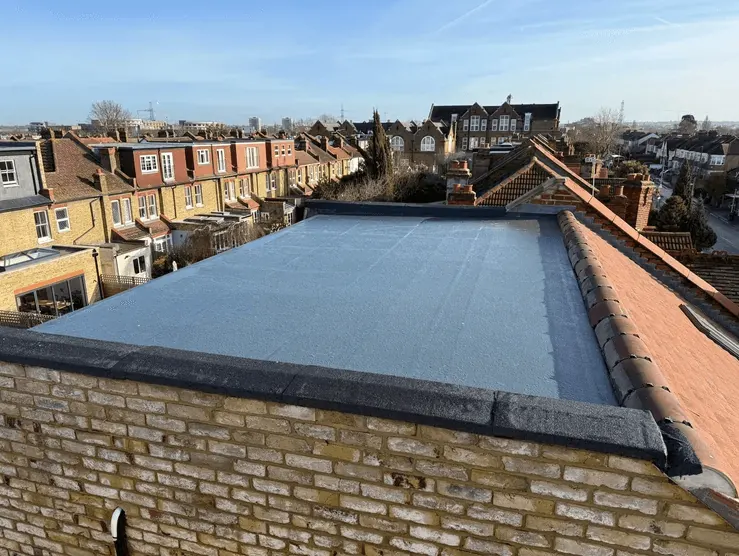
A roof that is sound apart from one split, one failed edge or a lifted flashing can usually be patched. A roof that leaks in several places, has blistered across most of its surface or has a soft deck underneath is better stripped and re-covered, because patching just moves the leak. We show you what we found, with photos, and explain which applies.
On a re-cover we strip the old covering, replace any rotten decking, correct the fall where the structure allows, and lay one of three systems with proper upstands and trims. GRP fibreglass gives a hard, seamless finish that suits small roofs with awkward corners. EPDM rubber goes on as a single sheet with very few joints. Torch-on felt is a layered system that still suits some roofs. Our main flat roofing page compares the three, and a new covering from us comes with a 10 year guarantee.
For a sense of scale, MyJobQuote's London flat roof guide puts replacing a 40 m² extension roof at £2,800 to £5,500 including materials and labour. Getting materials into a Triangle courtyard can add to that. If the flat roof is part of a bigger build, our page on new roofs in the Triangle covers the planning side.
Frequently asked questions
The workshop behind my Haynes Lane house has an old felt roof. Is it worth re-covering?
If the deck and joists are sound, yes. A re-cover is much cheaper than rebuilding the building, and it keeps the walls dry. If the timbers have rotted, they need replacing first, and we will tell you before you commit.
Our single-storey shop on Church Road has flats looking down on its roof. Does the finish matter?
It does to the people upstairs, and on a conservation area street the roof may be visible from the side roads too. We keep the surface even, the trims straight and the flashing tidy, whichever material we use.
How do you get materials onto a roof behind a Westow Street parade?
It depends on the building. It might be through the shop out of hours, through a back gate from a lane, or up and over from a neighbouring yard. We work it out at the quote and agree it with whoever needs to be involved.
How can I tell if the deck under the covering is rotten?
Soft or springy spots underfoot, sagging between joists and staining on the ceiling below are the usual signs. We check the deck before pricing a patch, so you are not paying to cover rotten boards.





