



 Google reviews

Eight units, one parapet: the 1-8 High Street crescent
Where the Ridgway turns into the High Street, the first thing you pass is a crescent-shaped parade of eight units. Merton's Village design guide describes it as a valuable parade with slate London roofs concealed behind a stone parapet, leading into the High Street from the Ridgway.
A London roof is built the opposite way round from an ordinary pitched roof. Its two slopes fall inward to a central valley, and that valley runs to the back of the building, where the water passes through the rear wall into a hopper head and down a pipe. Along the front, the parapet may have its own gutter behind it, draining through small outlets. All of the drainage is out of view: from the street, the only part anyone sees is a downpipe at the back.
That arrangement has three narrow points: the outlet through the rear wall, the hopper head that collects from it, and the downpipe below. A blockage at any of them backs water up into the valley. Because the valley is lined and sits inside the building's footprint, overflowing water goes into the top floor rather than over an edge.
Hopper heads, birds and what else blocks them
Hopper heads are open at the top, sheltered and often warm against a chimney breast or back wall, which makes them popular with pigeons and other birds. A nest built in a hopper can stop the flow almost completely, and old nesting material washed down from a parapet does the same lower in the pipe.
Other common causes on Village roofs:
- Moss and grit washed off old slate and clay tile, which settles at the lowest point of a valley.
- Broken slate and mortar from ridges or stacks, wedged in an outlet.
- Leaves and needles blown onto the roof from nearby gardens and the Village's mature trees.
- A failed fall in the valley lining, so water and silt sit short of the outlet.
In a conservation area, the hopper heads themselves are worth keeping. Many on older buildings are metal, some decorative, and they are part of how a rear or side elevation looks. We clear and repair them rather than swap them for something else unless they are beyond saving.
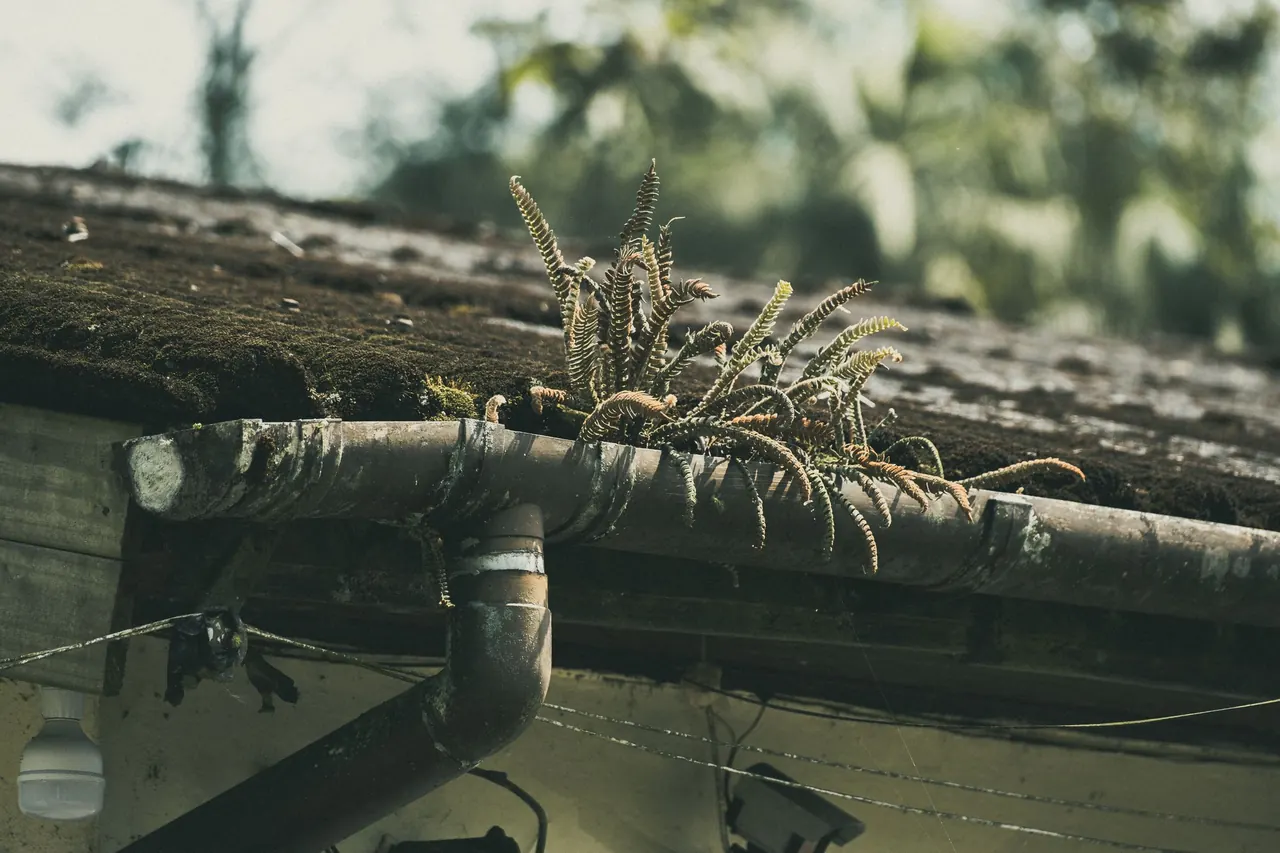
Clearing a hidden valley from the parapet down
We find the blockage first, which on a hidden roof usually means a drone flight over the parapet. Then we clear the valley and the parapet gutter along their length, clear the outlet through the wall, empty the hopper and rod or flush the downpipe to where it meets the drain. We run water through the whole system to prove it drains, and check for damage the blockage caused: split linings, slipped slates at the valley edge, and soaked timber.
The last step is the cause. That might be renewing a split valley lining, re-forming an outlet that is too small, or setting up regular clearing before the next nesting season. As a guide, Which?'s roofer cost guide puts clearing every gutter on a house at £75 to £350 excluding VAT, with repairs on top.
Routine clearing is covered on our Village gutter cleaning page, damaged runs on our page for gutter repairs in the Village, and water already coming through a ceiling on our emergency roof repair in the Village page. The main blocked gutter repair page has more on methods.
Frequently asked questions
Pigeons keep nesting in the hopper head behind our High Street shop. What can be done?
Once any nest is no longer in use, we clear the hopper and the pipe below it and check the outlet above. Most wild birds' nests are protected by law while in use, so timing matters, and regular clearing outside the nesting season stops material building up again.
Who arranges clearing a valley on a parade like 1-8 High Street?
Usually the freeholder or managing agent, since the valley and its outlet serve the building rather than one flat. We can report to them directly, with photos of the valley and the hopper.
Will you replace the old metal hopper head on our building with plastic?
Not unless you want us to. On conservation area buildings we clear and repair the existing hopper where it is sound, and if it is beyond saving we discuss a like-for-like replacement first.





