



 Google reviews

Rendered stacks on the 1840s villas
Leigham Lodge at No. 22 Leigham Court Road was the first house built on the road, in the 1840s. It is a double-fronted Italianate villa with a hipped slate roof, eaves brackets and, in the words of Lambeth's 2016 appraisal, immense rendered chimneystacks. Other Italianate villas on the road share its hipped slate roof, and every historic house in that conservation area still has its chimneys.
A rendered stack fails differently from a bare brick one. The render keeps the rain off the brickwork while it is sound. Once it cracks, usually first at the top where the weather is worst or along the line of the flashing, water gets behind it and has nowhere to go. It soaks the brick, freezes in winter and pushes more render off. From the street you might see a hairline crack. Up close, a whole panel can be hollow.
On a stack like this we look at the flaunching around the pots and at the lead where the stack meets the slate, because those are often where the water is really getting in, and we note the state of the render. We renew the lead and flaunching and reset the pots. If the render itself has failed across large areas, that is specialist work, and we will say so plainly in the quote rather than patch over it.
Tall brick stacks at No. 64 and The Grange
Further along the road there are other big stacks. The tall chimneystacks of No. 64 stand out in views along Leigham Court Road, and The Grange at No. 76, built in 1883, has big chimneys whose stock brick breasts were tinted red in 1900, when the stacks themselves were rebuilt. A stack that was rebuilt more than a century ago is due another close look.
On stacks this tall, the pointing near the top weathers out first, followed by the flaunching. We rake out and repoint the joints, rebed loose pots, and renew the flaunching so rain runs off rather than sitting round the pots. Where the lead at the base has lifted or split, we replace it with new stepped flashings and a back gutter on the uphill side.
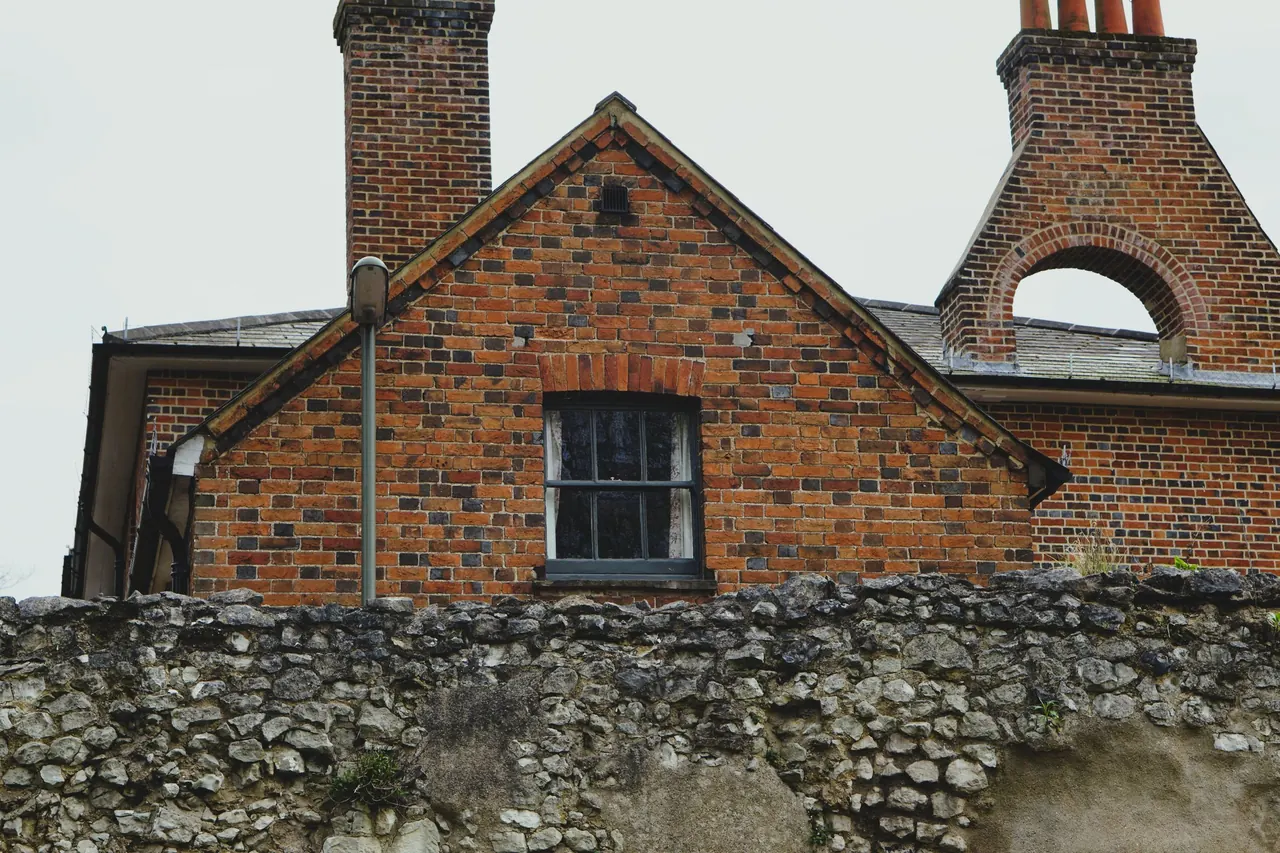
Stacks on Telford Park's gabled houses
West of the main road, the chimneys on Telford Park's Queen Anne houses come in many positions. Some rise from the ridge, some from a gable end, some from a side wall or against a higher wing. A stack that sits in a valley or tight against a gable gives the lead far more work to do than one on an open slope, and that is where damp in a top floor room most often starts.
Before deciding what is wrong, we look at the stack, the lead and the slopes around it, and check the loft for where the water is coming through. If the damp turns out not to be from the stack at all, the cause is often in a valley nearby, and our roof repairs in Streatham Hill cover the slopes and valleys around it. For general upkeep, our chimney maintenance guide explains what to look for from the ground.
Scaffold on a tall Leigham Court Road stack
Small jobs, such as refixing a length of flashing or resetting a pot, can often be done from roof ladders with proper safety equipment. Re-leading the whole stack, full repointing or rebuilding the top courses usually needs scaffolding around the stack, and on a tall villa that is almost always the case. A drone inspection before we quote shows the top of the stack close up, so the scaffold can be included in the price from the start.
As a guide, MyJobQuote's chimney flashing cost guide lists £700 to £920 for full leadwork replacement with scaffolding. Height, the size of the stack and the access around it move that figure either way. Our main chimney repairs page goes through each type of repair.
Frequently asked questions
The render on our Leigham Court Road stack has cracked. Is that why the room below is damp?
It can be, but the lead at the base and the flaunching on top are just as likely. We check those first, since they are the parts we repair, and tell you honestly if the render needs a specialist as well.
Our Telford Park stack sits against a gable wall. Why does the lead there keep failing?
Water running down the gable meets the stack and has to be turned by the lead. If the back gutter is too shallow or the flashings are short, it overflows in heavy rain. We usually renew the back gutter and step flashings together.
Can you rebuild the top of a tall villa stack to look the same as before?
Yes. We record the brickwork, oversailing courses and pots before taking it down, then rebuild to match. In a conservation area that is normally the expected approach.





