



 Google reviews

Rainwater on The Waldrons and Bramley Hill
The Waldrons Conservation Area was designated in May 1973, on part of the old Haling Park estate. Croydon Council's appraisal describes a private estate of mostly classical villas from the 1850s, with larger detached houses on Bramley Hill. Among the features it lists are slate roofs and prominent chimney stacks. It also records one of South Croydon's more unusual pieces of rainwater design: at 6 Bramley Close, one of a pair of Victorian Gothic houses, the rainwater from the roof drops into a carved lion's head and into a drain through its mouth.
Not every house has a lion, but the point holds. On a villa like these the gutters and downpipes are part of the elevation, not an afterthought, and a new system should look as if it belongs. A wide hipped slate roof also sheds a lot of water off a small number of corners, so the size of the gutter and the number of outlets matter as much as the material.
The appraisal asks owners to keep gutters and rainwater pipes clear as basic maintenance, because leaving them can lead to decay and more expensive repairs. A well-fitted system that drains properly is the starting point for that.
Profiles for the villas, the parades and the Croham Road houses
South Croydon has three broad kinds of house, and each suits a different gutter:
- Victorian villas: on The Waldrons, St Peter's Road and Birdhurst Rise, ogee is common on villas of this age, with its flat face and moulded front. Cast iron in ogee keeps the original line. Where cost or weight rules out iron, an ogee profile in another material is the closer match.
- Interwar houses: on the 1910s to 1930s streets around Croham Road, half-round suits most of them. uPVC is the usual choice, and aluminium is worth considering on long, plain eaves.
- Shop parades: on South End and Selsdon Road, gutters often run between gables and party walls. New sections have to join neatly to the neighbours' runs, or be stopped and drained at the party line.
Cast iron is the heaviest and longest-lived choice and needs painting to keep rust away. uPVC is light, cheap and needs little upkeep. Aluminium does not rust, comes in coated colours and can be formed into seamless aluminium runs where the eaves are long enough to make that worthwhile.
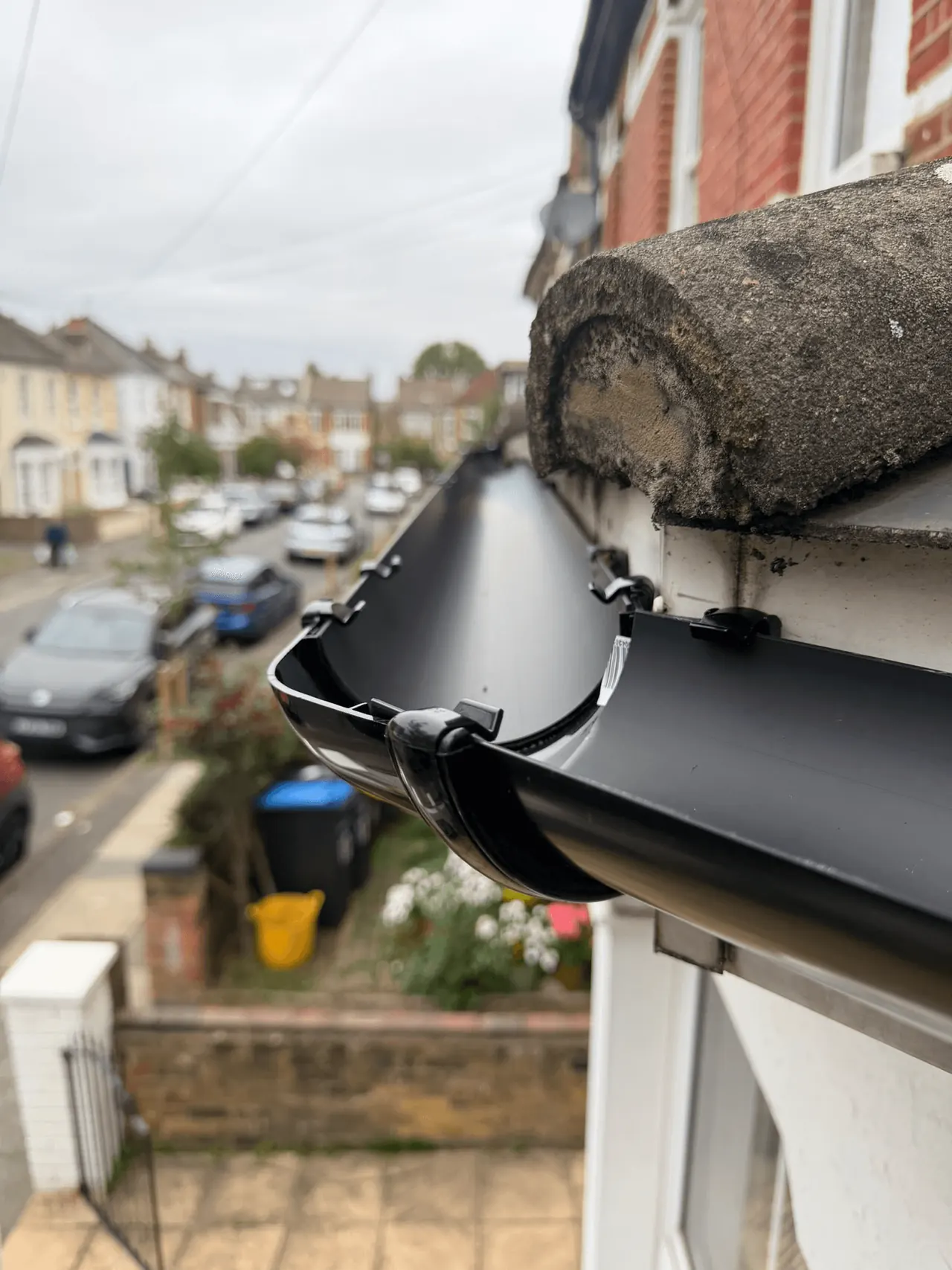
Fall, brackets and the drop to the drain on a sloping plot
A good-looking gutter still fails if the basics are wrong. On these houses we pay most attention to four things:
- Size: a big hipped or cross-gabled roof can need a deeper profile or an extra outlet. We work it out from the roof area, not by copying what was there.
- Fall: about 1:600 towards the outlet is the usual rule of thumb. On a long villa elevation, getting it wrong leaves a standing pool in the middle.
- Brackets: spaced to carry the gutter full of water and wet leaves, which on streets near Croham Hurst and Haling Grove is a real load every autumn.
- Fascia condition: brackets screwed into soft timber do not hold. We check the boards first, and where they have gone, replace them with our fascias and soffits service.
The downpipes go into a drain, soakaway or water butt, not onto the ground. On a sloping plot that matters: water left at the foot of the wall runs towards the lower side of the house and soaks in where you least want it.
For a sense of scale, Checkatrade's gutter replacement guide lists fitted uPVC at around £30 to £70 per metre. Cast iron ogee on a three-storey villa costs a good deal more once the access is added. The main gutter installation page compares the materials in more depth.
Frequently asked questions
Does The Waldrons Article 4 Direction cover my gutters?
No. The direction for 5 to 23 The Waldrons, in force since January 2016, covers hard surfaces and boundary walls, fences and gates. The house is still in a conservation area, so replacing cast iron with a different material on the front is worth checking with Croydon Council, but like-for-like replacement is straightforward.
Can a new downpipe on Bramley Hill run into the old drain at the foot of the wall?
Usually, if the drain is sound. We run water through it once the new pipe is connected. If it backs up or the gully is broken, we tell you, because a drain fault needs a drainage contractor rather than a roofer.
Do new gutters on a four-storey St Peter's Road villa need scaffolding?
Usually some access beyond ladders, yes. Lifting and fixing long lengths at that height, especially heavy cast iron, needs a stable platform, so a tower or scaffold is normally part of the job on the upper eaves. Lower runs over bays and back additions can often be done from ladders. We look at each elevation and include the access in the quote.





