



 Google reviews

The plain hips around the conservation area
Croydon Council's appraisal of the Croham Manor Road Conservation Area describes the streets around it as rows of suburban detached and semi-detached houses, mostly built between 1910 and 1933. They are not all alike. Where one of them has a plain hipped or gabled roof, with a straight run of eaves along the front and back and none of the catslides of the Chapman houses, it is a good candidate.
That is the shape that suits seamless guttering. On a house like this, a sectional gutter along the front might have a union every few metres, and each union has a seal that will eventually dry out and drip. Run in one piece, the same eaves has nothing to fail between the corners.
On a hipped interwar semi, the front and back runs are often the longest on the house, with short returns round the hips. Those long runs are where the switch makes the most difference.
Why the Chapman houses gain less
The Chapman houses on Croham Manor Road and Hurst Way are a different case. The appraisal describes steeply pitched roofs with catslides, gablets, individually designed dormers and overhanging eaves. That breaks the eaves into many short lengths at different heights, each with its own corners and outlet. Seamless aluminium still works on those runs, but when most of the joints are at corners anyway, there is little to gain from removing the ones along the straight.
Appearance counts too. These houses are locally listed and sit in a conservation area, and the appraisal names new materials that detract from the area's character as a threat. A traditional profile in a material that suits the house may be the better choice there, and we will say so.
The same applies lower down the hill. The Victorian villas on Birdhurst Rise and Campden Road have bays and gables, and on Birdhurst Rise the odd turret, that break the eaves every few metres, and their decorated bargeboards and eaves are part of what the council's heritage review values. Rear elevations are sometimes the exception, with one plain run where seamless works well. If a standard system suits your house better, our gutter installation in South Croydon page covers the options.
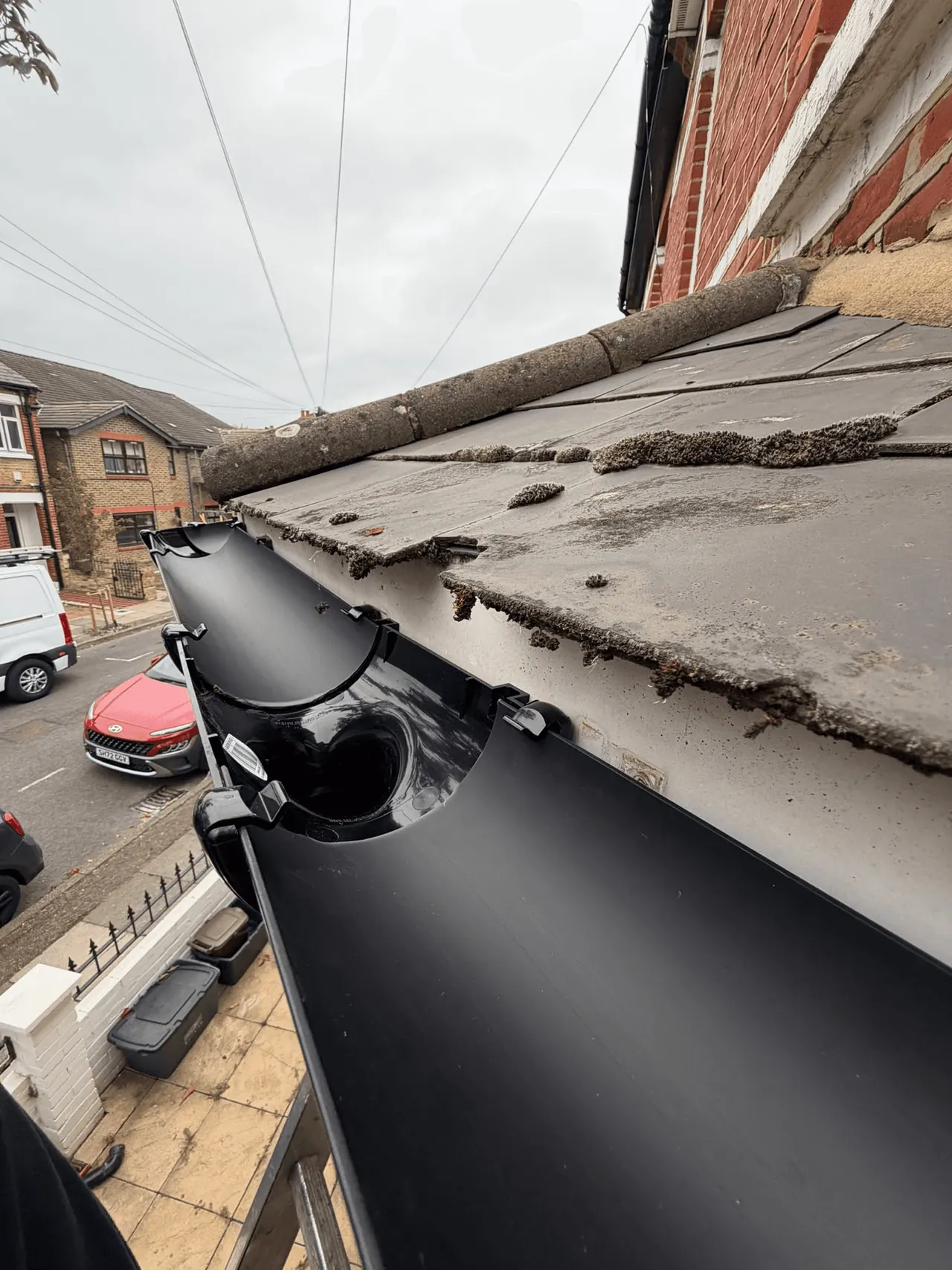
Measuring and fitting on a sloping street
Because each length is made to fit, we measure every run before anything is formed. On a sloping plot the eaves at the back can be a full storey higher than at the front, which affects the access and the length of the downpipes as well as the gutter.
Brackets are fixed at the correct spacing, the run is set to a fall of around 1:600 towards the outlet, and the corners and downpipe connections are formed and sealed. We then run water along each section to check for low spots. Brackets need a sound fascia to hold, so we check the boards before quoting, and if they have rotted, they are dealt with first.
Aluminium does not rust, is light enough for older fascias and comes in coated colours to match windows or boards. Under the trees near Croham Hurst it will still fill with leaves, so it needs clearing like any gutter, and our South Croydon gutter cleaning covers that.
MyJobQuote's guttering guide puts aluminium guttering at £55 to £78 per metre, supply and fit. A semi with long, easy front and back runs sits towards the lower end, and a house on a steep plot with tall back eaves towards the higher end. The main seamless gutter installation page explains the system in more detail.
Frequently asked questions
Is seamless guttering a good fit for the catslide roof on my Hurst Way house?
On the catslide itself, the run is usually short and low, so there are few joints to remove. Seamless may still make sense if the rest of the house has long plain runs and you want one system throughout. Otherwise a good sectional gutter in a traditional profile often suits the house better.
Would seamless aluminium look out of place on a Birdhurst Road villa?
On the front, it can. The council values the decorative eaves and bargeboards on these villas, and a modern box profile would stand out. We can show you the profiles available before you decide, and on a plain rear elevation the question matters much less.
Can a seamless run go round the hipped corners of my 1920s house off Croham Road?
Yes, but each corner is a joint. The straight runs are one piece and the corners are formed separately and sealed in. On a hipped house with four corners and two long runs, that still leaves far fewer joints than a sectional system.





