



 Google reviews

Front and back on Thurstan Road
A Thurstan Road cottage needing new gutters can have a mix already: some cast iron on the front, plastic at the back, and a downpipe that is a bit of both. Thurstan Road, Catherine and Marguerite Villas and the old hospital grounds are in Merton's Copse Hill conservation area, and its design guide notes that the original rainwater goods here were cast iron. When they are replaced, it says:
- Cast iron is more in keeping and generally more durable than plastic, and should be considered.
- Powder-coated aluminium looks very similar to cast iron, is lighter and can be cheaper.
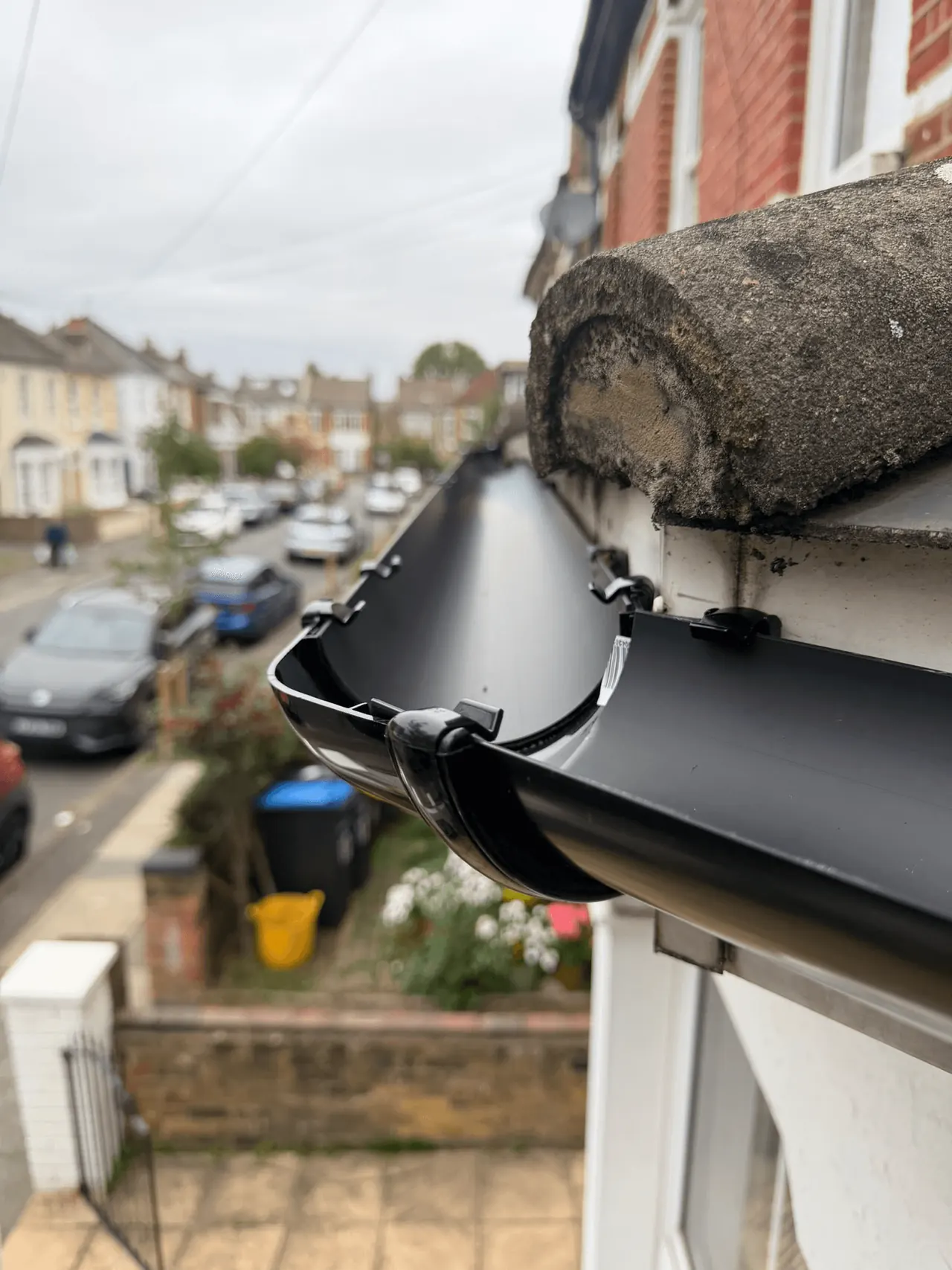
- If plastic is used it should be black. Cast iron or aluminium on the front and conspicuous side walls, with plastic on rear or secondary walls, is a good compromise.
- Cast iron and aluminium should not be combined, because of electrolytic erosion.
- Extra pipework on the front elevation should be avoided.
This is guidance rather than law, and there is no Article 4 direction. Following it keeps the street looking right. On Thurstan Road the paired front gables break each front eave into short lengths with stop ends and outlets close together, so a half-round or ogee profile in cast iron or lookalike aluminium is the natural fit there. At the back, black uPVC keeps the cost down without being seen from the road.
At Catherine and Marguerite Villas the bay roofs carry on across the front doors, and each small roof needs its own gutter. The guide's point about extra pipework matters here: where the falls allow, we take the porch gutter into an existing downpipe rather than adding a new one down the front wall.
Listed villas across the road
The tall houses on the south side of Copse Hill sit in a different conservation area, Wimbledon West, and several are listed: the Italianate pairs at Nos. 15/17 and 19/21, No. 23 and Colbyfield. On those, the Copse Hill guide does not govern the choice. Listed building consent does. Like-for-like materials are expected on the listed fronts, and any change of material should be agreed with Merton's conservation officers before work starts.
Weight is the practical issue. Cast iron is heavy, and on a three-storey villa a long run of it sits on brackets high above a front path. Where the council accepts it, aluminium made to look like cast iron gives the same appearance for far less load on the fixings. Where it has to be cast iron, the brackets and their fixings into the masonry matter as much as the gutter itself. Either way, a run this high needs a tower or scaffold to fit safely.
As for lifespan, MyJobQuote's gutter guide gives uPVC up to 25 years and metal gutters such as cast iron and aluminium up to 50 years when properly looked after.
Cottenham Drive, High Cedar Drive and the later houses
The later houses are simpler. Cottenham Drive dates from the 1960s, High Cedar Drive and Cedarland Terrace from the 1980s, and two more houses went up behind Nos. 7 and 7a in 1991. High Cedar Drive was left outside the conservation area, so owners there have a free choice. On most of these houses uPVC is the sensible, affordable answer, and where an eave runs long and straight our seamless gutter page explains the alternative.
New brackets are only as good as the board behind them, so if the fascias are soft our fascias and soffits work comes first. South of the road the ground falls away steeply, so we connect each new downpipe to the existing drain, soakaway or a water butt rather than leaving it to spill onto a slope.
Frequently asked questions
Can the porch roof at my Catherine Villas house drain without a new downpipe on the front?
Usually, yes. We can often run the porch gutter into the nearest existing downpipe, which keeps to the design guide's advice on avoiding extra pipework on the front elevation. We look at the falls before promising it.
My Thurstan Road cottage has a cast iron gutter at the front. Can the new back gutter be aluminium?
Yes, as long as it is a separate run and is not joined to the cast iron. The design guide warns against combining the two because of electrolytic erosion, and the joint is where corrosion would start.
Our flat is in one of the converted villas on Copse Hill. Who decides what the new gutters are made of?
The freeholder or managing agent normally arranges work to the outside of the building, and on a listed villa the council has a say in the material. We can quote to the managing agent and set out the like-for-like option for the conservation officer. If only one length has failed, our gutter repair page may be the better place to start.





