



 Google reviews

Why concrete tiles are coming off the Heaver Estate
Over the twentieth century, some roofs between Balham High Road and Tooting Bec Common lost their slate to concrete tiles. It looked like an upgrade at the time. Wandsworth's appraisal for the Heaver Estate now lists concrete tiles among the changes that undermined the terraces, says the heavy tiles have threatened the stability of some houses, and notes that some owners have had to go back to slate because of the extra weight.
The appraisal describes natural Welsh slate as the most durable covering, with a life expectancy of more than fifty years. Since the two Article 4 directions of 1996, re-covering a road-facing roof in a different material needs planning permission on most of the estate. In practice, a re-roof on Streathbourne, Louisville or Ritherdon Road means natural slate on the front, crested clay ridges reused or matched, and new lead at every abutment.
Taking concrete off has one more step. The rafters have spent decades under a heavier load than they were built for, so once the tiles and battens are stripped we check for sagging or split timbers and strengthen anything that needs it before the new battens go on.
Louisville Road's patterned bays
Some Heaver groups need more than plain slating. The appraisal records the flats at 2 to 38 Louisville Road, built in 1898 by Alfred Heaver to designs by Williams C. Poole to look like terraced houses, with three rows of patterned slates on their bay roofs and clay ridge tiles. Most were built as flats divided horizontally, each with its own front door, which means a re-roof is usually a shared decision between the upstairs and downstairs owners.
Where the bay pattern has survived, it is recorded before stripping so it can be laid again in the same rows. Where it has been lost, a re-roof is the time to put it back.
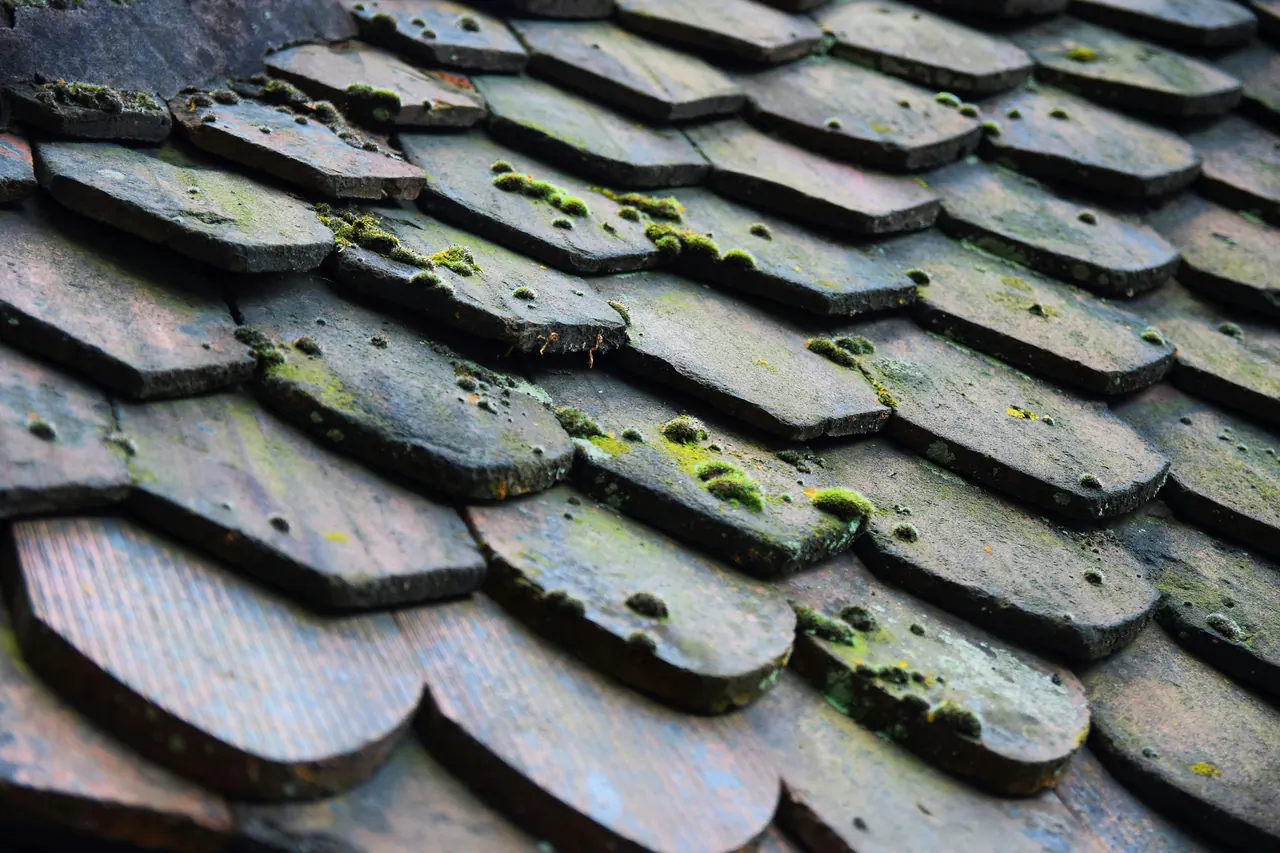
Hyde Farm: matching slate, size, colour and texture
On the Lambeth side of Cavendish Road the rules are written out in full. Lambeth's Hyde Farm statement says re-roofing in anything other than a closely matching natural slate, in size, colour and texture, will not get planning permission, and that concrete, artificial slate and fibre cement are not acceptable. Where a roof has already been covered in concrete, a return to slate is strongly encouraged.
Ridge tiles, flashings and finials must copy what is there. The terracotta ridge tiles and finials have to be kept and reused, the copings on the brick party wall up-stands repaired to match, and decorative bay slating reproduced exactly. Lambeth's statement says that where re-roofing on the estate has gone wrong, the cause is usually a poor match of materials or details. So the old ridges and finials are lifted and set aside, not broken up in the skip.
With the scaffold up, it is also the cheapest time to deal with the roofline, and we can quote for fascias and soffits in the same job. Our main roof replacement page covers how a re-slate is priced.
Frequently asked questions
Should the patterned bay roof on Louisville Road be redone at the same time?
Usually yes, while the scaffold is up. If the bay is leaking or the pattern has been lost, re-slating it to the original three rows makes sense in the same job, and it saves putting access up twice.
What happens to the terracotta finials on a Hyde Farm roof when it is stripped?
They are lifted with care, stored and put back. Lambeth's guidance says decorative terracotta ridge tiles and finials must be kept and reused when a roof is redone, and missing ones should be reinstated to match.
Will the rafters on my Heaver Estate house take natural slate again after years under concrete tiles?
Slate is lighter than concrete tile, so the load goes down, not up. What we check is whether the timbers have sagged or been damaged while carrying the heavier tiles, and we repair or strengthen anything that needs it first.
Do I need permission to re-roof my converted flat off Nightingale Lane?
Very likely. Wandsworth's Nightingale Lane appraisal says flats, maisonettes and houses converted to flats in the conservation area need planning permission for reroofing. Check with the council before booking the scaffold, and see our guide on deciding between a repair and a new roof if you are not yet sure it needs one.





