



 Google reviews

Right to buy has given every roof its own history
For decades the council looked after every roof on the St Helier estate. Since right to buy began in 1980, many homes have been bought by their tenants, and each owner since has made their own choices. One house in a terrace may still carry its original pantiles or slate. The next may have been re-covered in concrete tiles, and the one after that patched a few tiles at a time. The terrace still reads as one roof, but it is really several roofs of different ages, joined at the party walls.
That is the case for an inspection before you buy, and for another one when a ceiling stain appears that nobody can explain. A mortgage valuation usually looks at the roof from the ground. It may note that the covering "appears original" without saying what that means for the nails, the battens or whatever is laid underneath.
What the energy certificate in a sales pack misses
Buyers on the Carshalton side often have an energy certificate in hand before anything else. A current one for an end-terrace on Middleton Road, SM5, records a pitched roof with 100 mm of loft insulation and filled cavity walls. That is useful, but it is about heat, not water. It says nothing about slipped slates, cracked pantiles, perished underlay or the state of the join with the roof next door.
A certificate does give two hints. If the assessor recorded a loft insulation depth, they probably looked into the loft, so there is usually a hatch we can use. And a thinly insulated loft under a low-pitched roof is a cold space, where condensation and old leaks leave staining on the rafters. That staining is one of the first things we look for, because it shows where water has been even when the roof is dry on the day.
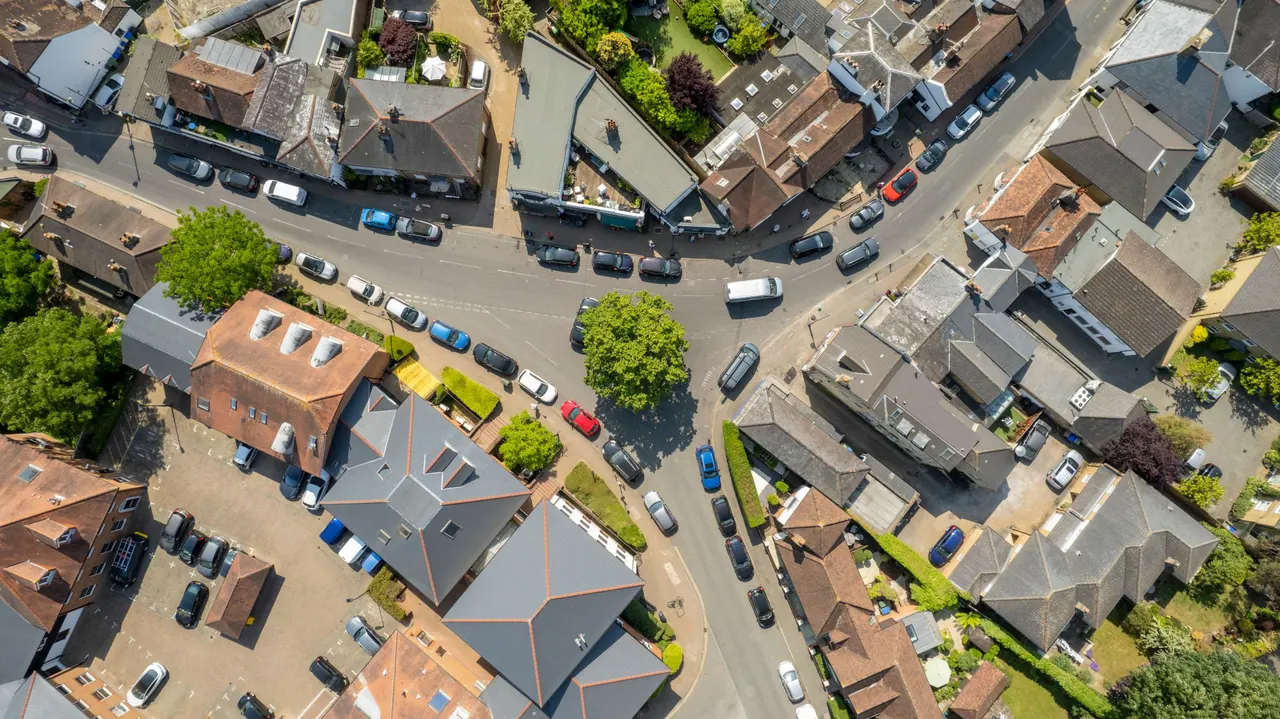
Checking a low-pitched estate roof, slope by slope
The covering. On pantiles we look for cracked tiles, tiles that have lifted where they interlock, and mortar lost from the verge and ridge. On slate we look for slipped and flaking slates and for the rusted nails that let them slide. On later concrete tiles we check that the tile chosen suits a shallow pitch, because not every tile does.
The party wall lines. Where your section meets each neighbour's, we look at how the two coverings were joined. A badly made junction lets water travel along a batten before it drips, so the stain inside can be some distance from the fault.
The front. Porch roofs, door canopies on their curved brackets and the tops of bays all meet the main wall, and many porches have since been infilled with a small flat roof. Each of those joints is checked.
The loft. We look for daylight, damp timber, staining on the rafters, and whether the party wall runs up to meet the underside of the roof.
The eaves. A gutter that overflows at the back can look like a roof leak from inside, so gutters, fascias and soffits are part of the look.
The drone photographs the back slope of a mid-terrace house without scaffolding or a ladder against a neighbour's wall. The photos are reviewed with Simranjeet, our roofing surveyor, and you see them too, so a buyer, a seller or a neighbour can be shown the problem rather than told about it. If work is needed, our St Helier roof repair page explains how repairs are handled on these terraces, and our article on roof checks before buying a house in Sutton lists the questions worth putting to a seller. What a full survey covers in general is set out under roof inspections.
Frequently asked questions
The EPC for the Middleton Road house I am buying shows 100 mm of loft insulation. Does that mean the roof is fine?
No. An energy certificate measures heat loss. It does not look at tiles, slates, flashings or the underlay, so a roof can score well on insulation and still let water in.
The terrace I am buying has two different tiles along the front. Is that a problem?
Not on its own. It usually means one house was re-covered and the next was not. What matters is how the two were joined at the party wall and whether the newer tile suits the pitch, which is what we check.
Next door is still rented from the council. Can you look at our section without going on their roof?
Yes. The drone views your section and the junction with next door from the air, so nobody needs to stand on the neighbouring roof. If their side looks likely to cause trouble for yours, the photos give you something to send to the council as landlord.





