



 Google reviews

Where these roofs leak: the junctions
Merton Hall Road's semis were built with a main ridge running parallel to the road and smaller gables facing the front. Merton Council's Merton Hall Road appraisal describes the terraces further south with a gable or a hip over every bay, and party and flank walls projecting through the roof line all along the road. On Quintin, Richmond and Chatsworth Avenues almost every house has a gable to the street. Built between 1884 and 1907, these roofs have far more junctions per metre than a plain hipped roof, and junctions are where water gets in.
On roofs built like these, the usual failure points are:
- Valleys behind bay gables: the valley collects lime leaves and grit, its lining wears, and water appears on a front bedroom ceiling close to the outside wall.
- Party wall upstands: the mortar fillet or flashing along each side cracks as the house moves, and water runs down inside the wall.
- Nails and battens: after more than a century, corroded nails let single slates or tiles slide out of line.
- Ridges and hips: old bedding mortar shrinks and cracks, and a ridge tile can lift in a gale.
Cones, spires and ridge tiles
Some repairs here are on roofs few other streets have. The appraisal records conical slate roofs over the round ground-floor bays at 25 to 31 Merton Hall Road and eight-sided spire roofs on the corner tower at 45 and the turret at 156. The Wimbledon Chase appraisal notes that some houses on the avenues keep ornate ridge tiles, while others have lost them. A cone or a spire has to be slated with every slate cut to the curve or the facet, and the joint where it meets the wall is usually lead.
We keep sound slates and tiles from the roof itself and match the rest, using reclaimed material where new does not match in colour or size. On a front slope the best matches go where they will be seen. Where an original ridge tile or finial is cracked rather than lost, we reset it rather than swap it for a plain one.
Long Lodge and the parapet roofs on Kingston Road
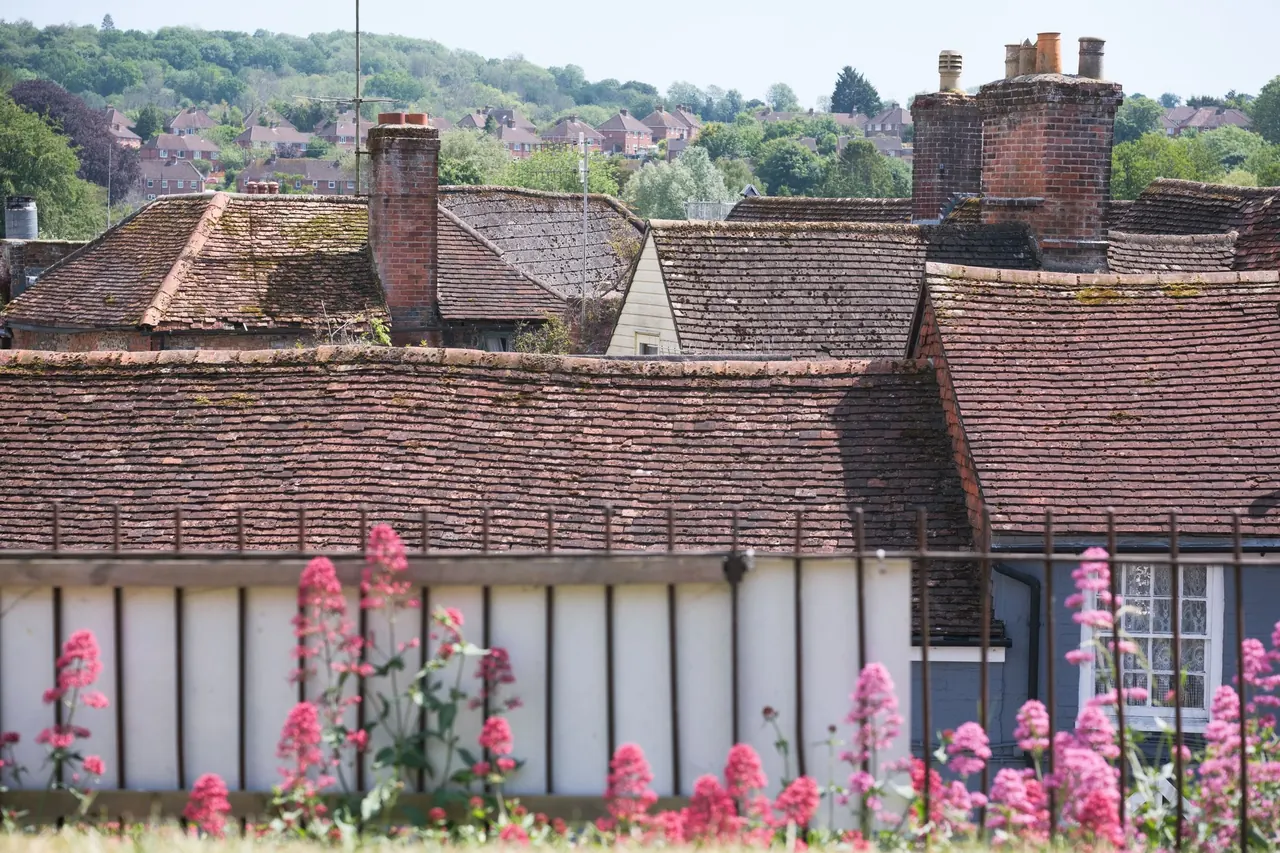
Kingston Road adds a different set of roofs. Long Lodge, at 267a/269 and listed Grade II, has wings whose parapets partly hide shallow pitched roofs, and 271 next door, built in 1981 on the site of the old Leather Bottle pub, has a parapet too. Behind a parapet the rain runs to a hidden gutter and out through an outlet. When the lining of that gutter splits, or the flashing where the roof meets the back of the parapet cracks, water comes into the building with nothing showing outside, and the first sign is a stain on a top-floor ceiling. Repairs there mean working on the lining and the parapet flashing, not the slope.
On a listed building, check with the council before any repair that changes materials. Merton Park Parade's long hipped roof is broken through by every party wall, and the 1903 shops at 279 to 291 have gables to the road, each with its own valley. If you own a flat above one of the shops, the roof may be shared with other owners or a freeholder, and the quote can set out exactly which part of the roof the repair covers.
Pricing a repair north of Henfield Road
One of our roofers looks at the roof, takes photos where it helps you see the fault, and explains what has failed and why. If a slate has slipped, we look for the reason: a corroded nail, a rotten batten or water coming in from above. The two-and-a-half-storey houses on the east side above Henfield Road take more access than the two-storey avenues, so the same repair can cost more there.
As a national guide, the Which? roofer cost guide puts replacing one to six standard tiles at £75 to £400 excluding VAT, and notes London prices tend to sit at the upper end.
If faults are showing in several places at once, our article on repair versus replacement explains how to weigh it up, and re-roofing in Merton covers the bigger job. For water coming in right now, go to emergency roof repair in Merton.
Frequently asked questions
The conical slate roof over my round bay on Merton Hall Road is losing slates. Can it be repaired?
Yes. Each slate on a cone is cut to a taper, so replacements are cut to match and fixed to follow the curve, replacing only what has failed. The lead or mortar where the cone meets the wall is checked at the same time, since that is where these small roofs usually let water in.
Some of the ornate ridge tiles on my Richmond Avenue roof are cracked. Can they be saved?
Often, yes. A cracked ridge tile can usually be lifted and rebedded, and a broken one replaced with a reclaimed match. Some houses on the avenues have already lost theirs, so keeping the originals is worth the effort.
The fillet along the party wall on my Chatsworth Avenue roof has been patched twice. Why does it keep failing?
A sand and cement fillet is rigid, and the wall and the roof move at different rates, so it cracks again. Replacing it with lead flashing stepped into the brickwork usually ends the problem. Our main roof repair page explains how we approach repairs like this.





