

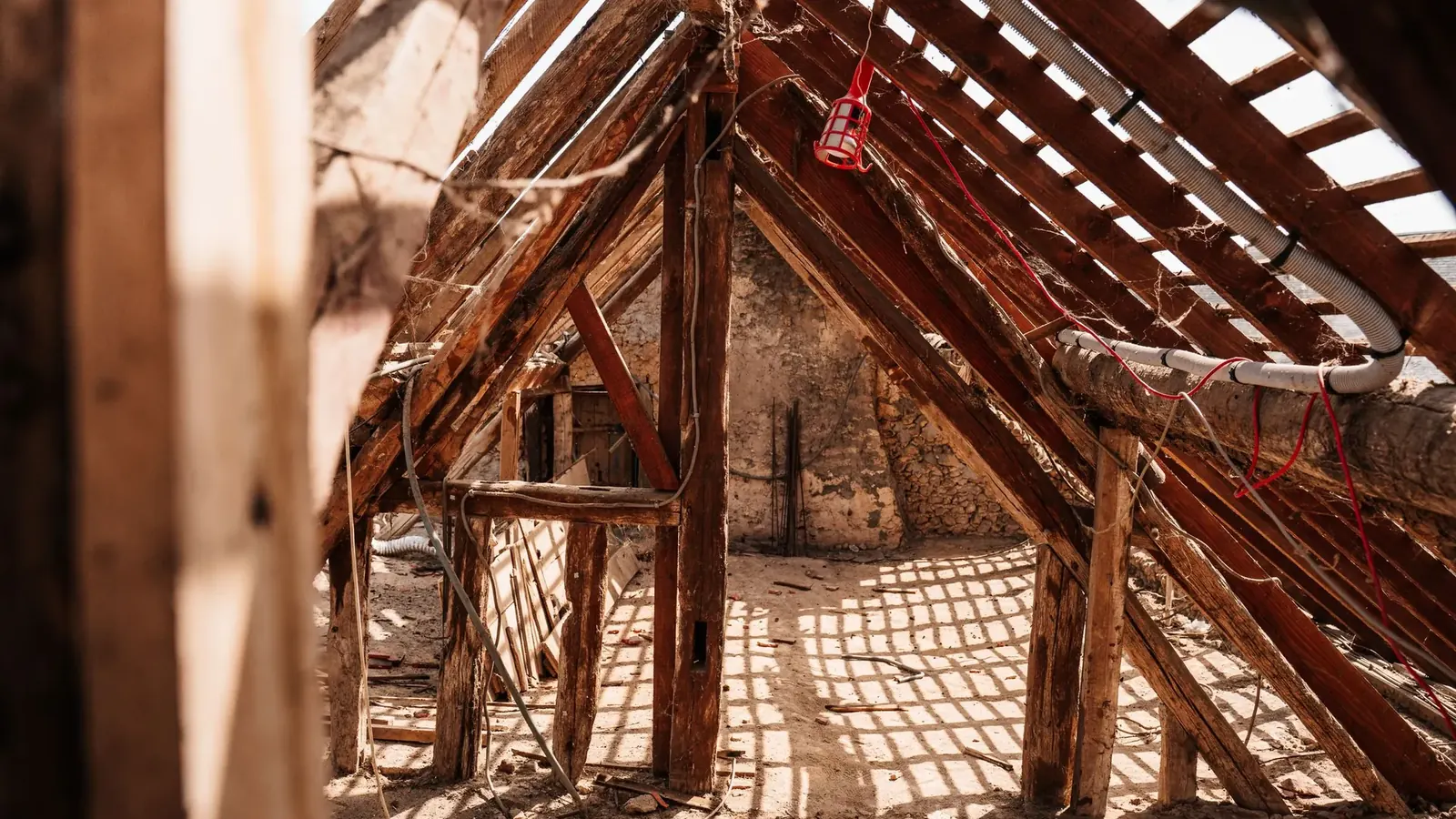
How to find a roof leak: work from the inside out. Mark the stain, find the same spot in the loft, then follow the wet trail uphill along the rafters and underlay to where it starts. Note when it leaks and the wind direction, then check that part of the roof from the ground. The entry point is often a metre or more from the stain.
In short
- Map the stain, find the same spot in the loft and follow the wet trail uphill to its highest point
- Keep a log of rain, timing and wind direction; UK prevailing winds are west to south-westerly
- Check the matching part of the roof from the ground with binoculars, never from a ladder in bad weather
- Hidden leaks may need a drone survey, a controlled water test or lifting tiles
If water is coming through fast, finding it can wait. Make the room safe, catch the water and call us on 0330 133 4111; we take emergency calls 24 hours a day and our first job is to stop the water.
Before you start: what you need and what not to do
You will need a strong torch, a pencil or chalk, a tape measure, your phone for photos, and something to kneel on in the loft. A dry day for the loft check and a wet one to watch the leak in action are ideal.
This method keeps you inside the house, in the loft and on the ground. Do not climb onto the roof or up a ladder to look, and never in rain, wind or the dark. The HSE advises that all roofs should be treated as fragile until a competent person has confirmed they are not, and names falls from roof edges and through fragile roofs and rooflights as the main causes of death and injury in roof work. In the loft, stand or kneel only on the joists or on boarded areas; the ceiling between the joists will not hold your weight.
How to find a roof leak from inside: five steps
- Map the stain. Draw lightly round the damp patch and measure from it to two fixed points: the nearest outside wall and the party wall or gable. Photograph it with the date. Those measurements let you find the same spot in the loft.
- Find the spot in the loft. Measure the same distances from the inside face of the walls. Lift the insulation above the stain and look for wet plasterboard, a tide mark or damp wood.
- Follow the water uphill. From the wet spot, look up the rafters and along the underside of the felt or boards towards the ridge. Water runs downhill along timber, felt, pipes and cables, so follow the dark streaks, drip marks and rust on nail tips upwards until they stop. The highest wet point is where water is getting through the underlay, and the entry point on the outside is usually at or just above it.
- Look for light. On a bright day, switch off the loft light and let your eyes adjust. Any daylight showing through the roof marks a gap in the covering. Push a thin piece of wire or a straw through a gap only if you can do so from inside without disturbing the underlay; it gives you a marker to spot from outside.
- Go back when it rains. During steady rain, return to the loft with the torch and watch. Seeing where the first drop forms is the most reliable clue of all. Lay a plastic sheet under the area so you can see fresh drips.
If the loft is wet in lots of places rather than one, and worst on cold mornings, you may be looking at condensation rather than a leak. The NHBC notes that roof-space condensation usually appears when it turns cold or there is a big drop between day and night temperatures. Our guide to condensation in the loft explains how to tell.
Why the stain is rarely under the hole
Pitched roofs have two layers that keep water out: the tiles or slates, and the underlay beneath them. Water that gets past a slipped tile lands on the felt and runs down it until it finds a tear, a sag or a lap that has opened, which may be well below the tile. From there it can run along a batten, down a rafter, across the top of the ceiling and along a cable or pipe before it finally drips.
That is why a stain in the middle of a bedroom ceiling can come from a chimney, and why a patch near the outside wall can come from a gutter rather than the roof at all. Insulation also spreads the water sideways, so the wet patch on the ceiling is often bigger and more diffuse than the original drip.
Flat roofs are harder still. Water that gets through a split can travel a long way across the deck under the covering before it finds a joint in the boards, so the leak inside can be at the opposite end of the roof from the defect.
Timing the leak with the weather
Keep a simple record each time it leaks: the date, how heavy the rain was, how long after it started the drip appeared, and the wind direction from a weather app. Patterns narrow things down quickly.
- Leaks only in wind-driven rain. Points to the side facing the wind: flashings, verges, tiles lifted at the edges or a roof window. In London that is most often the west or south-west, since the Met Office describes the UK's prevailing winds as west to south-westerly.
- Leaks in any heavy rain, but not light rain. Points to something that overflows: a valley, a gutter, a flat roof outlet or a parapet gutter. Our guide to a roof leaking in heavy rain covers these.
- Leaks hours after the rain starts, then carries on after it stops. Water is soaking into something first, often a chimney stack, brickwork or a saturated flat roof deck.
- Leaks every time it rains, even lightly. A clear gap: a missing tile, a hole in a flat roof or a lifted flashing.
- Leaks with no rain at all. Probably plumbing or condensation. See our guide to a water stain on the ceiling.
Checking the roof from the ground
Once you know roughly where to look, go outside with binoculars, or zoom in with your phone camera, from the garden, the street or an upstairs window. Compare the area above the leak with the same spot on the neighbours' roof if you live in a terrace or semi.
| Where the water shows inside | Entry points to look at first |
|---|---|
| Next to a chimney breast | Lead flashing round the stack, cracked flaunching, open pots |
| Below where two slopes meet | The valley: debris, split lead, slipped valley tiles |
| Along the top of an outside wall | Eaves felt, blocked or sagging gutter, slipped bottom-course tiles |
| At the gable end | Verge mortar or dry verge units, tiles at the edge |
| Near the ridge | Ridge tiles and their mortar or fixings |
| Around a roof window | Flashing kit, debris at the top of the window, seals |
| Where an extension or dormer meets the house | Abutment flashing, upstands, cavity tray |
| Mid-slope, nowhere near a junction | Slipped, cracked or missing tiles or slates; failed underlay below |
On Victorian and Edwardian terraces with a butterfly roof, the central valley and the parapet or box gutters are frequent culprits; our guide to roof valley leaks goes into them. On slate roofs, slates sliding out of line in a band usually means corroded nails, covered in our guide to nail sickness.
How a roofer finds the leaks you can't
Some leaks hide well, especially on flat roofs, around chimneys and where several details meet. This is how a roofer usually closes in on them:

- Loft and roof together. We look at the loft first, then match what we find to the outside, because the inside tells us which part of the roof to look at.
- A drone inspection. A drone gives close-up photos of every slope, the chimney, valleys and flashings without scaffolding or anyone walking on the tiles. It cannot see under the tiles, so it is always paired with the loft check.
- A controlled water test. Roofers often run water over one area at a time with a hose, starting low and working upwards, while someone in the loft watches for the first drip. This is a two-person job done from proper access, not something to try from a ladder.
- Lifting tiles. Once the area is narrowed down, lifting a few tiles shows whether the underlay, battens or flashing beneath have failed.
For guide prices, MyJobQuote (updated October 2026) puts a basic visual roof inspection at £100–£200 and a drone roof survey at £200–£350, and lists thermal or moisture scans at £300–£500, often used on flat roofs with difficult-to-find leaks. These are national guide figures that do not state a VAT basis, not our prices; we confirm any cost in a free quote first.
When to stop looking and call a roofer
Your own detective work is worth doing, because it saves time on the visit. Stop and call a roofer when you have traced the leak to the outside of the roof, when the water is near electrics or the ceiling is sagging, when you cannot find the source after a couple of rain events, or when the leak keeps coming back after a previous repair.
Bring us your notes and photos: where the stain is, the measurements, when it leaks and the wind direction. Our roof repair team uses that to go straight to the likely area, and if you want the whole roof checked, a roof inspection covers every slope, the loft and the gutters.
Frequently asked questions
How do you find a roof leak when it isn't raining?
Use the loft. Look for old drip marks, tide lines on rafters, rust on nail tips and stained underlay, and follow them uphill to the highest point. On a sunny day, turn the loft light off and look for daylight through the roof. A roofer can run a controlled water test over the suspect area to reproduce the leak.
Can a roof leak be far from the stain?
Yes, and it usually is. Water that gets past the tiles runs down the underlay, along battens, rafters, pipes and cables before it drips onto the ceiling, so the entry point can be a metre or more higher up the slope and to one side. On flat roofs it can travel across the whole deck.
What is the most common place for a roof to leak?
Junctions are the usual suspects: chimney flashing, valleys, the joint where an extension or dormer meets the house, and around roof windows. After that come slipped or broken tiles and slates, then failed underlay on older roofs. Blocked gutters and valleys are a common cause that is easy to mistake for a roof defect.
Should I put sealant on the roof to stop a leak?
No. Sealant or bitumen applied over the outside of a roof rarely lasts, often traps water, and hides the real entry point, which makes the proper repair harder and sometimes more expensive. It also means going on the roof, which is not safe without the right access. Catch the water inside and get the cause repaired.
How long does it take a roofer to find a leak?
A straightforward leak, such as a slipped tile above a stain, can be found on the first visit. Leaks around chimneys, valleys and flat roofs can take longer, sometimes a water test or a return visit in rain. Good notes on when it leaks and the wind direction shorten the search considerably.
Tracking down a leak in Morden and the surrounding area
Precise Roofing & Guttering is a family run roofing team based on Kenley Rd in Morden, covering Merton, Sutton, Kingston, Wandsworth and the neighbouring boroughs. Call us with what you have found and we will arrange a visit, check the loft and the roof, and use the drone where slopes are hard to see. Quotes are free and often same day, our repairs carry a 10 year guarantee, OAPs get 20% off, and we answer emergency calls around the clock. Call 0330 133 4111 or request a free quote online.




 Google reviews
