



 Google reviews

Who looks after your roof on the estate
The first question with any roof fault in Roundshaw is whose job it is, and the answer depends on how you hold your home. The estate is managed by the housing association MTVH, which keeps an office on the estate, open five days a week, and a dedicated local surveyor. Homes on an estate like this can be rented, leasehold or freehold, and a house bought under right to buy may now belong outright to its owner.
- MTVH tenants: report roof and gutter faults to MTVH. Repairs to the structure are normally the landlord's job under a tenancy.
- Leaseholders in a block or maisonette: the roof is usually part of the building the freeholder maintains, with the cost shared through the service charge. Check your lease before booking any work.
- Freehold owners: the roof is yours to maintain, and that is the work we quote for.
If you are not sure which group you are in, your title deeds or lease will say. It is worth settling before a roofer goes up, because work arranged by the wrong person can mean paying twice.
Why most roofs here are young
Roundshaw sits on the eastern edge of the London Borough of Sutton, on land that was part of Croydon Airport until it closed in 1959. The street names keep the link: Mollison Drive, Lindbergh Road, Olley Close, Avro Way and Brabazon Avenue all take their names from aircraft, aviators or the firms that built the planes. A short patch of the old runway tarmac survives in Roundshaw Park, west of Purley Way.
Building started in 1965 and the first tenants moved in during August 1967. The first estate was largely brutalist pre-cast concrete flats and maisonettes, heated from one communal boiler house. In 1998 Sutton Council began a partial demolition and rebuild that ran until 2010 and cost about £80m, according to the history of the estate. About 1,000 concrete system flats and maisonettes came down, including the high-rise Instone Close, imploded in November 2000. Low-rise houses and brick-built flats took their place, the boiler house went, and homes were given their own heating.
Two kinds of pitched roof
That rebuild left most pitched roofs in Roundshaw in one of two groups.
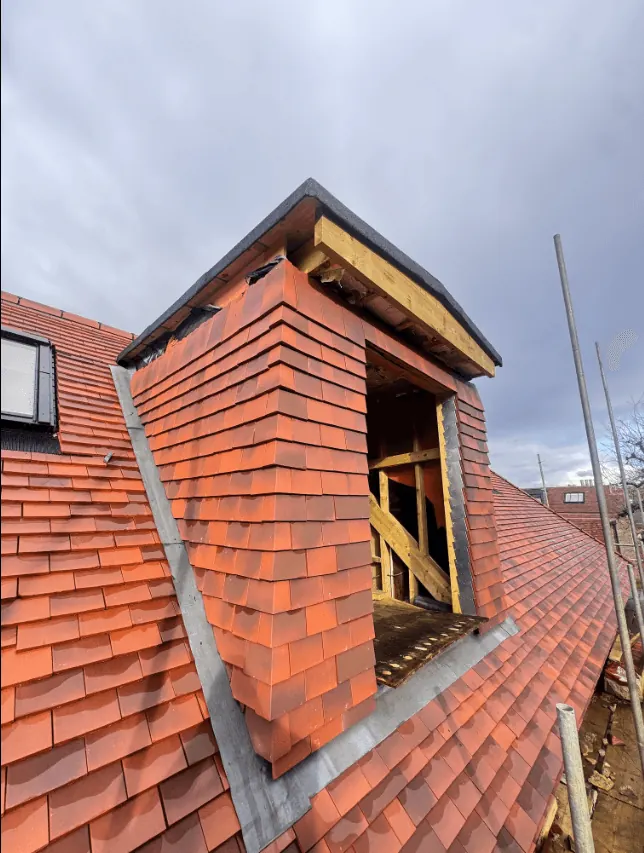
- The 674 kept homes. These brick-built homes from the original estate were refurbished rather than demolished, and they were given pitched roofs as part of the work. The places that need watching on them are the junctions where the added roof meets the walls, the next house and the eaves.
- The rebuild houses and brick flats. These went up in phases between 1998 and 2010 on the sites of the demolished blocks, so their roofs were built with the houses beneath them.
Either way, most roofs here are likely to be somewhere around 15 to 30 years old. That is an estimate rather than a record, because individual roofs may have been re-covered since. At that age, concrete interlocking tiles are often still in fair shape. What usually needs attention first is the ridge and verge fixings, the flashing where a roof meets a wall, the gutter joints and the roofline boards. Our Roundshaw roof repair page explains which faults show first on the exposed rows facing the Park and the Downs.
One building is different again. Barnard Close is the only refurbished block from the original concrete system estate that is still standing, so it is a different kind of building from the houses around it, and work on its roof is arranged by the building's owner.
Open ground, leaves and seed
Roundshaw has a lot of open space for a housing estate. Roundshaw Park lies along the south-west side, with Lindbergh Road, Mollison Drive, Vulcan Way and Barnard Close on its edge. To the east, Spitfire Road, Redwing Road and Lancastrian Road sit beside Roundshaw Park Playing Fields. Further south, Apeldoorn Drive and Rheingold Way back onto Roundshaw Downs, a 52.7 hectare stretch of chalk and neutral grassland with woodland and scrub, part of which is a local nature reserve.
Where scrub or trees are close to a back garden, leaves and seed end up in the gutter behind the house, which is the one nobody sees from the street. Our gutter cleaning in Roundshaw page covers the rows closest to the Downs. For a roof that is simply hard to see from your garden, a Roundshaw roof inspection by drone shows the slopes without anyone climbing or putting up scaffold.
Getting a price
For a freehold house, the usual first step is a look at the roof and a written quote for whatever needs doing, with the faults shown in photos. If you are a leaseholder, send the same photos to your freeholder or MTVH, since they will want to see them before agreeing who pays. You can see the full range of work on our services page, or use the contact page to ask for a quote.
Frequently asked questions
I bought my Roundshaw house under right to buy. Is the roof now mine to look after?
If you bought the freehold of a house, yes. If you bought a flat or maisonette on a lease, the roof is normally still maintained by the freeholder and recharged through your service charge. Your lease or your solicitor's report will say which applies.
My home is one of the 674 kept from the original estate. What should I watch on its roof?
The pitched roof was added during the regeneration, so the junctions matter most: where the roof meets a wall or the next house, and along the eaves. Damp at the top of an upstairs wall after driving rain is the sign to look for.
My Mollison Drive house shares one roof line with the neighbours. Can just my section be repaired?
Yes. On a terrace each owner is responsible for their own part of the roof. Where a repair runs up to the party line, we finish it cleanly at the boundary and let you know if we see anything on the neighbour's side that they should look at.
Can you work on the roof of the Barnard Close block?
Only if the building's owner asks us to. A block roof is the freeholder's responsibility, so residents should report faults to MTVH or their managing agent rather than booking a roofer themselves.





