



 Google reviews

The 1967 block at no. 22 North Side
On the North Side, one block of flats breaks the run of villas. Lambeth's conservation area appraisal lists flat roofs among the roof types in the area, and the clearest example is no. 22 Streatham Common North Side, a red brick block of modernist flats built in 1967 with a flat roof and large regimented windows. Benhurst Court, also on the North Side, is an interwar block in the International style.
A flat roof on a block like no. 22 is a big single surface, and by now it may have been re-covered once or twice already. Large flat roofs fail in a few typical places: around the outlets, where water collects if the deck has sagged; at the upstands against lift or stair housings; and along the edge trims, which take the wind. When a large roof is re-covered, the deck and the falls to the outlets need checking as well as the membrane, or the new covering ends up sitting in the same puddles.
Work on a block is arranged with the freeholder or managing agent. We inspect first, by drone if there is no safe roof access, and quote with photos so the leaseholders can see what they are paying for.
Kitchen returns and integral garages on Southside
Behind the houses on both sides of the common, the appraisal describes a wide range of rear returns and extensions. Many end in a single-storey kitchen or utility room with a flat roof, often added in stages over the years. On Southside, the 1931 pair at nos. 30 and 31 was built with integral garages, and garages and side additions on the interwar houses commonly carry flat roofs too.
Flat roofs at the back of the North Side and Southside have one local problem in common: leaves. The upper common is oak woodland, Southside has its plane avenue, and back gardens are full of mature trees. A few big plane leaves across an outlet, or acorns lodged in it, can turn a flat roof into a shallow pond, and standing water shortens the life of any covering. Our guide to water pooling on a flat roof explains when a puddle matters.
Older felt roofs from the 1980s and 1990s are now past their normal life. A sound roof with one damaged area can be repaired. A roof with leaks in several places, widespread blistering or a soft deck is better stripped and re-covered:
- GRP fibreglass suits kitchen returns and dormers with awkward shapes and upstands.
- EPDM rubber goes down as a single sheet, which suits larger, simpler roofs such as garages.
- Torch-on felt is the traditional option and still suits some roofs and budgets.
For scale, Checkatrade's flat roof guide puts GRP at around £107.50 per square metre. Size, the state of the deck and access through the house all move the figure.
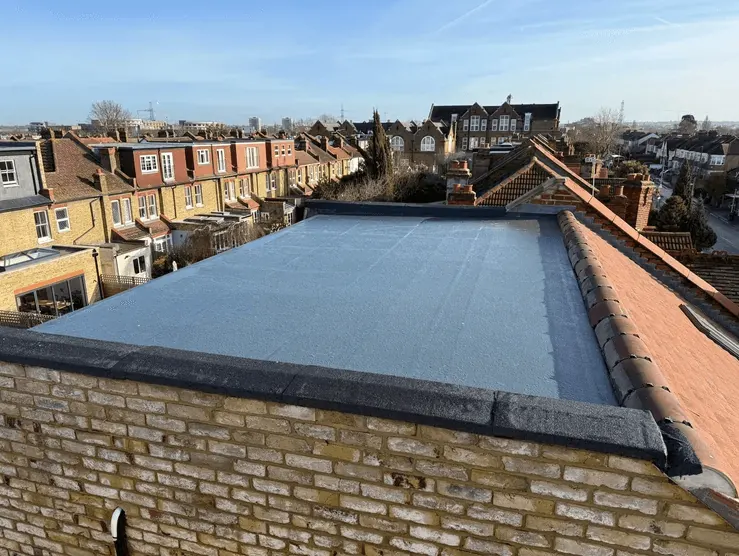
Re-covering the flat top of an existing dormer
Many loft conversions on the Streatham Lodge Estate and around the common already have a rear dormer with a flat top, often felted when it was built. Re-covering that top in the same way is maintenance, not a new alteration. Planning questions about new dormers and front slopes, including the Article 4 Direction on the Lodge Estate, are covered on our roof installation page for Streatham Common.
The re-cover still needs care. A dormer top is small, but it is surrounded by junctions: the covering has to turn up behind the lead or tile on the dormer cheeks, tuck under the main roof at the back edge and finish at a drip that throws water into a gutter clear of the main roof valleys. Most leaks on dormer tops start at those edges rather than in the middle of the sheet, which is why GRP, with its moulded trims, is often the neater answer here. If the gutter the dormer drains into is tired, gutter repairs on the same house can be done on the same visit, and the main flat roofing page has more on materials.
Frequently asked questions
Can the flat roof on a block like no. 22 North Side be re-covered in stages?
Sometimes, if the roof is divided by upstands or the budget has to be spread out. The deck and outlets need checking across the whole roof first, so the first stage does not drain onto an old section.
The flat top of my rear dormer on Braxted Park leaks at the edge. Does the whole top need redoing?
Not always. If the leak is at one trim or where the covering meets the cheek, that edge can often be repaired. If the felt has blistered and cracked across the top, a full re-cover is the longer-lasting answer.
Acorns keep blocking the outlet on my kitchen roof near the woods. Is there a better outlet?
Clearing it once the oaks have dropped is the main answer. If the outlet is too small for the roof, the next re-cover is the time to fit a larger one, so a few acorns are less likely to flood it.





